Code
from lastmoon.figures.signal_amplitudes import plot_signal_amplitudes
from lastmoon.figures.style import apply_style

apply_style()
plot_signal_amplitudes()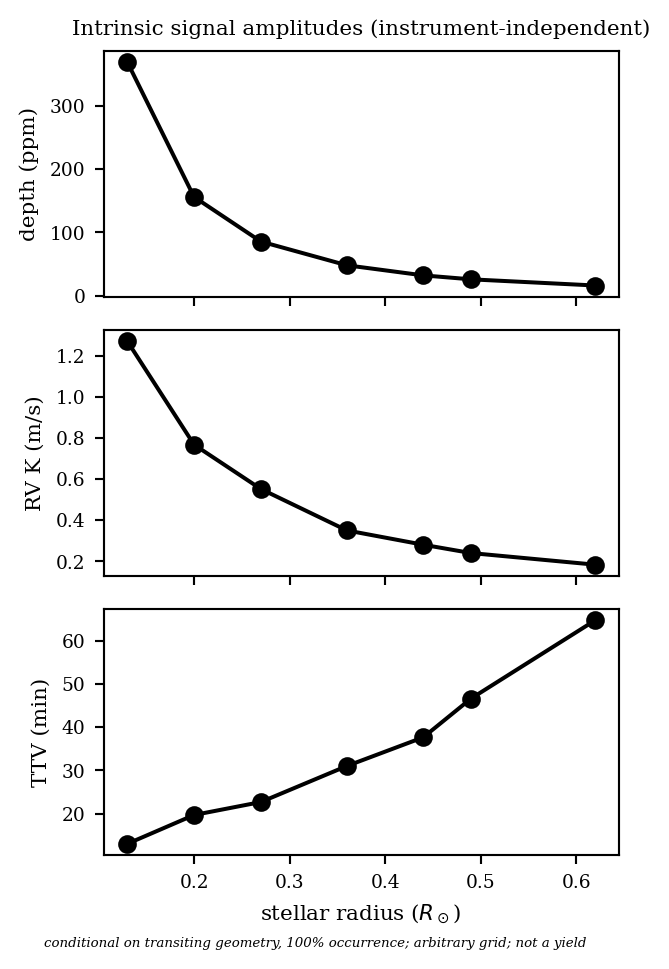
Surviving exomoons as tracers of planet-mass black holes — and a technosignature of planetary conversion
A sufficiently advanced civilization may convert its home planet into a planet-mass black hole — an Earth-mass black hole has a Schwarzschild radius of about nine millimetres and a Hawking temperature of about 0.02 K, so it is effectively dark. Because the conversion is approximately mass-conserving, a pre-existing moon survives on essentially its original orbit and becomes an occulting test particle tracing the gravity of an invisible primary.
That surviving moon is both the detection handle — the moon’s large transit-timing variations (TTVs) encode the primary’s planet-mass directly; the only body that ever transits is moon-sized; radial velocity and astrometry would corroborate the mass but are not yet within reach — and the artificial-vs-natural discriminant (we quantify how rarely nature could counterfeit the full configuration).
from lastmoon.figures.signal_amplitudes import plot_signal_amplitudes
from lastmoon.figures.style import apply_style
apply_style()
plot_signal_amplitudes()
Or jump to Getting Started to run everything yourself.