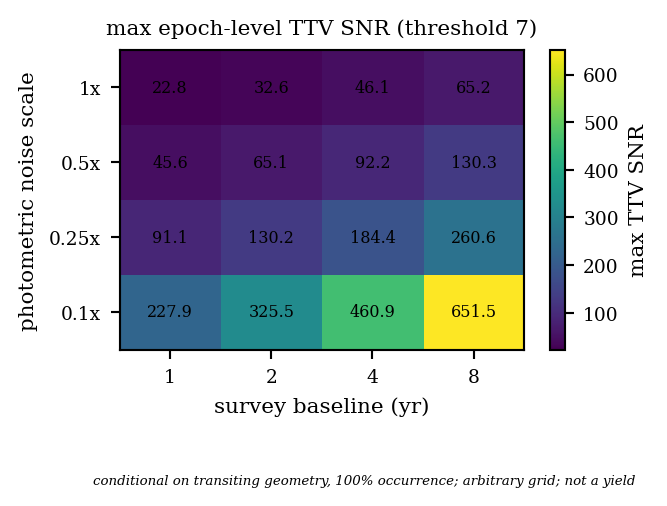
The analytic TTV signal-to-noise treats the moon’s maximum projected displacement as a cleanly recoverable sinusoid. Real surveys sample the moon’s orbit only at transit epochs, with unknown phase and a possibly tilted orbit — and a fitted transit ephemeris silently absorbs part of the signal. The epoch-level forward model accounts for all of it, and the honest number is what decides whether the system clears the SNR-7 detectability gate — the screening step for candidacy. Reaching a technosignature candidate verdict additionally requires surviving the impostor model-comparison test (see Ruling Out Impostors), and confirming the dark primary needs the RV mass-mismatch, which is further out of reach.
Both the grid and the real nearby M-dwarfs are now on the same near-IR (2MASS J) band, so the two sets of numbers are directly comparable. Under an idealized continuous-coverage model the grid’s best cell (M6V at 5 pc) reaches TTV SNR ~32.6 — well past the SNR-7 candidacy threshold — and 8 of the 28 cells (all M5V–M6V through 20 pc) clear it; the three named M-dwarfs — stellar and instrument benchmarks, not candidate systems — clear it too (TRAPPIST-1 ~25, Proxima ~23, Barnard’s ~13). Because a systematic floor dominates the noise budget, the candidacy count is floor-limited (4–8 of 28 over a 20–30 ppm floor). This is a feasibility statement, not a schedulable JWST yield, and the absolute primary mass stays alias-limited (the moon period is stroboscopically aliased). M-dwarf activity red-noise is no longer negligible now that the white timing precision is ~125 s: it costs ~3% at a 30 s activity floor and ~28% (down to ~23.5) at the 120 s upper end — but the best cells stay above the SNR-7 gate throughout. The Domingos stability cap (0.49 R_Hill) would support still larger TTV signals (SNR ~80 at the best cell).
Code
from lastmoon.figures.confirmation_frontier import ( frontier_sweep_table, plot_confirmation_frontier,)fig = plot_confirmation_frontier(frontier_sweep_table())fig
The candidacy frontier: where longer baselines and better photometry push the epoch-level TTV SNR past threshold. Conditional on transiting geometry and 100% occurrence; illustrative grid, not a yield.
The forward SNR is a known-period matched-filter statistic: it assumes we know the moon’s orbital period when fitting. A blind period search does pay a look-elsewhere penalty, but the paper now quantifies it rather than leaving it open: conditional on the already-detected outer ephemeris, the moon-period search spans only the aliased sub-sampling band — a few tens of independent trials — so a Baluev extreme-value correction raises the threshold only modestly, to ρblind ≈ 7.6–7.7, which all eight candidacy cells still clear. Retaining SNR = 7 is therefore conservative, not optimistic. The transits themselves are still idealized as central, box-shaped events on a quiet star; that caveat carries into the manuscript.