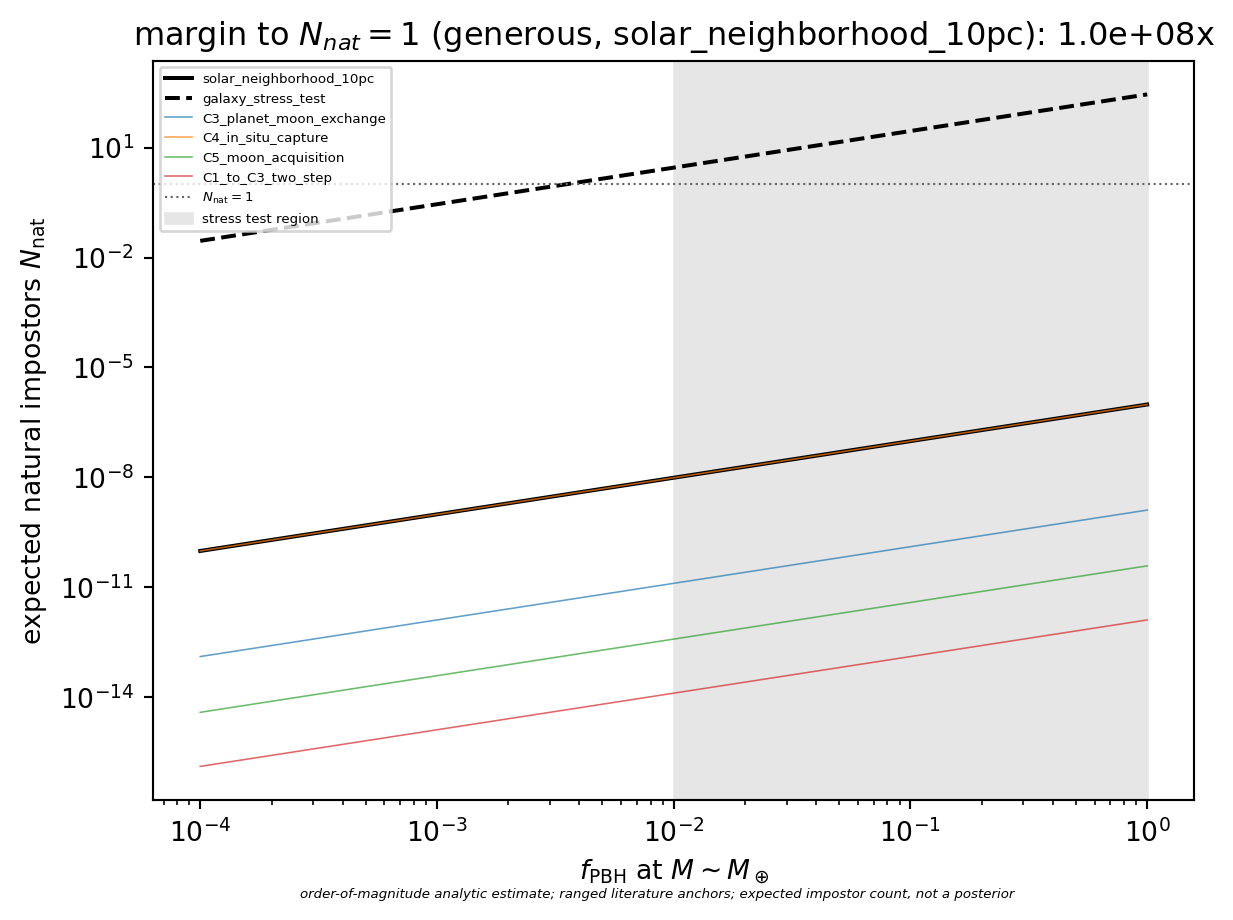
The whole argument rests on one question: can nature — specifically, a captured primordial black hole (PBH) — produce a planet-mass black hole on a circular habitable-zone orbit that carries a moon? We answer with an expected count of natural impostors, Nnat, in a searched stellar population, summed over every capture/exchange channel we could construct.
Code
from lastmoon.naturalness import ( GALAXY_STRESS_TEST, SOLAR_NEIGHBORHOOD, NaturalnessInputs, estimate_naturalness,)inputs = NaturalnessInputs()for ctx in (SOLAR_NEIGHBORHOOD, GALAXY_STRESS_TEST): res = estimate_naturalness(inputs, ctx)print(f"{res.context_label}:")print(f" N_nat nominal {res.n_nat_nominal:.2e}, generous {res.n_nat_high:.2e}")print(f" margin to N_nat = 1 (generous): {res.margin_to_unity:.1e}x")for name, count insorted(res.per_channel_nominal.items(), key=lambda kv: -kv[1]):print(f" {name}: {count:.2e}")
Even at the most generous-to-nature end of every input, the expected impostor count is computed live above — these numbers regenerate from the package on every site build, so they always match the code.
Code
import matplotlib.pyplot as pltfrom lastmoon.naturalness.figure import plot_naturalness_keystonefig = plot_naturalness_keystone()plt.close(fig)fig
The keystone figure: expected natural impostors vs the PBH dark-matter fraction.
Caveat: order-of-magnitude analytic estimate; ranged literature anchors; expected impostor count, not a posterior.
NoteWhat this means for the paper
Nnat is reported, never asserted: the code computes an expected count with explicit, swept, literature-anchored inputs, and the count is far below one for the searched 339 systems within 10 pc (Reylé et al. 2021), but a deliberate galaxy-wide stress test reaches ~2.87 at the generous corner — crossing unity — reported rather than tuned away. A detection where N_nat ≪ 1 makes the natural hypothesis unlikely; inferring deliberate engineering additionally requires a prior on planetary conversion — which the paper flags as the weakest, unquantified anchor (population-level discriminator, not individual certification).
WarningIdealizations
Order-of-magnitude analytic channel sum with ranged inputs — not a few-body simulation. The searched population is the 339 systems within 10 pc; the Galaxy number is an explicit stress-test extrapolation.