The moon’s transit-timing variations weigh the unseen companion dynamically — this is the primary mass channel; radial velocity would corroborate it but is not yet within reach. Transit photometry sizes whatever crosses the star. For a normal planet, mass and size agree. Here they cannot: the mass is a planet’s, but the only thing that ever transits is a moon — and the body that carries the mass never transits at all, even though the moon’s small orbit carries it across the stellar disk at every non-grazing moon transit.
The one geometry that could hide the primary — a grazing outer orbit, whose primary misses the disk while the moon still transits — is computed rather than assumed. Marginalizing the two-body sky geometry over the survey model’s declared priors, that configuration carries 2.7% of the prior mass given only that the moon transits at least once, and less than 2.8×10⁻⁶ once a regular full-chord series (≥90% of the predicted epochs) is required. That is a prior-predictive miss probability under the declared conditioning — not a frequentist coverage statement, and not a posterior probability that the primary is small: the geometry-averaged completeness of the primary-transit search is better than 1 − 2.8×10⁻⁶.
Code
from lastmoon.physics import constants as cfrom lastmoon.physics.orbits import orbital_velocityfrom lastmoon.physics.signatures import mass_size_mismatch, transit_depth# Reflex (RV) semi-amplitude of a Sun-like star from an Earth-mass companion at 1 AUk_rv = orbital_velocity(c.AU, c.M_SUN) * (c.M_EARTH / c.M_SUN)depth_moon_sun = transit_depth(c.LUNAR_RADIUS, c.R_SUN)depth_earth_sun = transit_depth(c.R_EARTH, c.R_SUN)mismatch = mass_size_mismatch(c.M_EARTH, c.LUNAR_RADIUS)print(f"RV semi-amplitude (Earth-mass at 1 AU, Sun-like star): {k_rv*100:.1f} cm/s")print(f"Transit depth if the EARTH transited: {depth_earth_sun*1e6:.0f} ppm")print(f"Transit depth actually observed (Moon-sized): {depth_moon_sun*1e6:.1f} ppm")print(f"Mass/size mismatch factor: {mismatch:.1f}x")
RV semi-amplitude (Earth-mass at 1 AU, Sun-like star): 8.9 cm/s
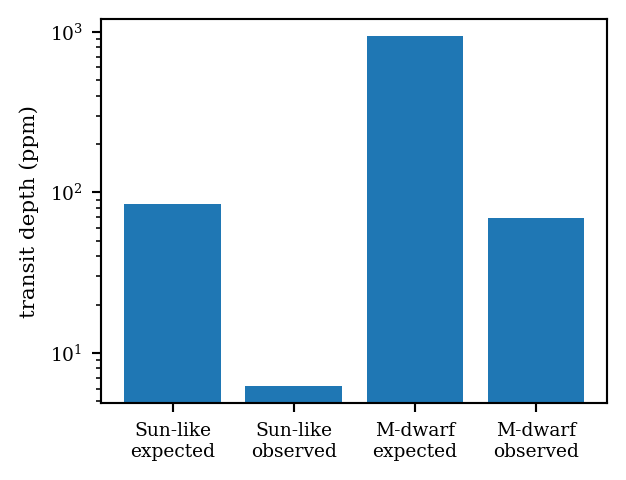
Transit depth if the EARTH transited: 84 ppm
Transit depth actually observed (Moon-sized): 6.2 ppm
Mass/size mismatch factor: 3.7x
The dynamical mass predicts a rocky body 3.7× larger in radius than anything that transits. That ratio is a proxy: the transiting radius belongs to the moon, not to the body carrying the mass. The constraint that actually bounds the primary is the absence of its own transit:
Code
from lastmoon.physics.signatures import ( primary_density_lower_bound_kg_m3, primary_radius_upper_limit_m,)from lastmoon.survey.instruments import JWSTr_star =0.3* c.R_SUNdelta_lim =3.0* JWST.floor_ppm *1e-6# single-visit 3-sigma at the 20 ppm floorr_p_max = primary_radius_upper_limit_m(r_star, delta_lim)rho_p_min = primary_density_lower_bound_kg_m3(c.M_EARTH, r_star, delta_lim)print(f"Earth-radius primary transit depth at 0.3 R_sun: {transit_depth(c.R_EARTH, r_star)*1e6:.0f} ppm")print(f"Non-detection at {delta_lim*1e6:.0f} ppm bounds the primary radius to < {r_p_max/1e3:.0f} km")print(f"Earth-mass primary inside that radius: density > {rho_p_min/1e3:.0f} g/cm^3")
Earth-radius primary transit depth at 0.3 R_sun: 934 ppm
Non-detection at 60 ppm bounds the primary radius to < 1617 km
Earth-mass primary inside that radius: density > 337 g/cm^3
Around an M-dwarf the same geometry is far more favourable:
Figure 1: Expected vs observed transit depth (TTV is the primary mass channel; RV corroborates when in reach).
NoteWhat this means for the paper
The mass-size mismatch is flagged first by the TTV (the leading dynamical channel), and corroborated when — and if — RV reaches the required precision. The primary’s density bound comes from its absent transit (an Earth-radius primary would show a ~930 ppm event at 0.3 R☉; its non-detection at 60 ppm gives R_p ≲ 1617 km and ρ_p ≳ 337 g/cm³ at the Earth-mass branch). The moon-radius proxy (~272 g/cm³) coincides numerically only because R_p,max happens to sit near the Moon’s radius. The bound tightens for the smallest stars, where the same depth limit corresponds to a smaller radius — exactly where small-star surveys look. The paper’s mock survey quantifies which instruments can reach both channels.
WarningIdealizations
Circular edge-on orbits; the terrestrial mass-radius relation R ∝ M^0.27 for the “expected” rocky radius; no limb darkening or noise.