The transiting moon does not cross the star on a fixed schedule: it orbits the dark primary, so its transits arrive early or late (transit-timing variation, TTV) and last longer or shorter (transit-duration variation, TDV). Because the thing we watch is the moon, the signal is unattenuated — unlike a conventional exomoon search, where the moon’s tiny mass barely budges its luminous planet.
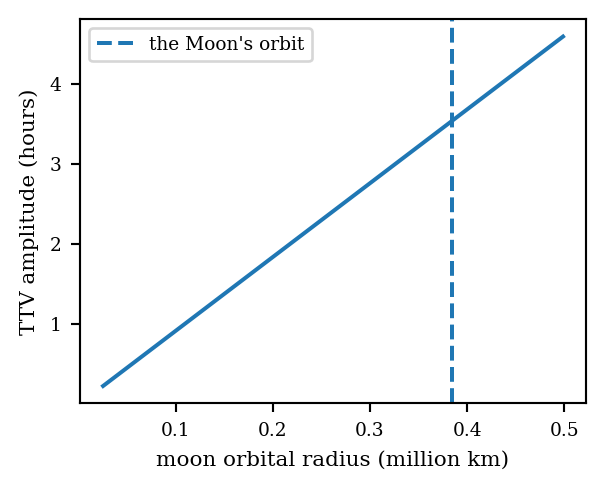
A 3.5-hour timing wobble is enormous by exoplanet standards — conventional single-planet transits show no such wobble, and while planet-on-planet TTVs can reach large amplitudes near mean-motion resonance, the moon case is separated by TTV morphology (period locus, chopping, TTV/TDV quadrature), not amplitude alone — see Ruling Out Impostors. The amplitude grows with the moon’s orbital radius up to the stability limit:
Code
import matplotlib.pyplot as pltimport numpy as npfrom lastmoon.figures.style import apply_stylefrom lastmoon.physics.orbits import hill_radius, max_stable_moon_semi_major_axis_mapply_style()a_max = max_stable_moon_semi_major_axis_m(c.AU, c.M_EARTH, c.M_SUN)a_moon = np.linspace(0.05, 1.0, 60) * a_maxttv_hr = [ttv_amplitude(a, c.M_EARTH, c.LUNAR_MASS, v_bary) /3600for a in a_moon]fig, ax = plt.subplots()ax.plot(a_moon /1e9, ttv_hr)ax.axvline(c.LUNAR_SEMI_MAJOR_AXIS /1e9, ls="--", label="the Moon's orbit")ax.set_xlabel("moon orbital radius (million km)")ax.set_ylabel("TTV amplitude (hours)")ax.legend()fig
TTV amplitude vs moon orbital radius (up to the Domingos 0.49 R_Hill stability ceiling).
The detectability analysis in the paper uses the conservative 0.20 R_Hill fiducial (well inside the Domingos cap, and at the zero-kick moon-side tidal inner edge — a conservative floor, not a recoil optimum) as the headline orbital radius.
NoteWhat this means for the paper
TTV/TDV is the dynamical fingerprint that turns “a small transiting thing” into “a small thing orbiting an invisible planet-mass point” — and because the primary is a perfect point mass (no oblateness, no tides on it), the forward model is cleaner than for any real planet-moon pair.
WarningIdealizations
Maximum projected amplitudes (circular coplanar orbits, full phase coverage); the paper’s survey module treats recoverability more conservatively.