Finding hidden masses with an array of ticking clocks
GPS only works because general relativity is wired into it. The satellite clocks sit higher in Earth’s gravitational well than yours, so they tick fast (by about 45 microseconds a day) while their orbital speed slows them down by about 7. The net drift, roughly 38 microseconds a day, sounds like nothing; uncorrected, it would smear your position by kilometers within hours. Engineers treat this as a nuisance to be subtracted away.
But flip the logic around. If gravity changes how fast a clock ticks, then a clock’s tick rate is a measurement of gravity. Scatter clocks through a region of space, watch which ones run slow, and you can infer where the hidden mass is and how heavy it is, a gravity detector built from nothing but timekeeping. This site builds that detector: a forward model from summed Newtonian potentials and a pedagogical weak-field rate map, a particle filter for the inverse problem, and a series of increasingly hard detection puzzles.
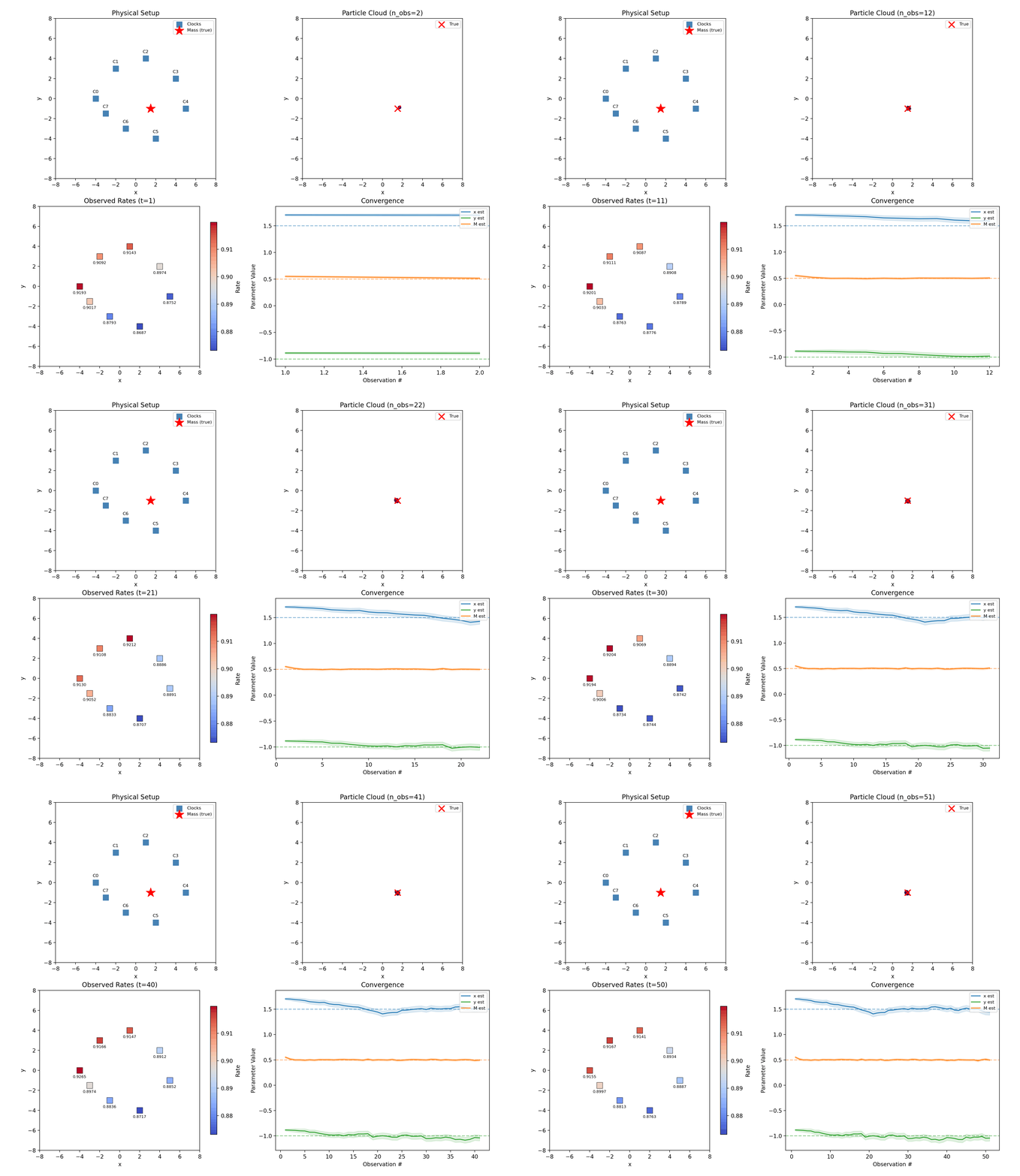
Current 2D inference demo showing the physical setup, particle cloud, parameter traces, and observed tick rates.
NoteGenerated-evidence status
The committed GIFs and PNGs were regenerated from the corrected physics and SMC implementation after one-shot certification. They show named finite runs; they do not establish population reliability or universal recovery rates.
Here is the whole round trip — simulate noisy clock readings near a hidden mass, then recover it: