Everything on this site rests on one weak-field result from general relativity: a clock sitting at Newtonian potential \(\Phi\) (which is negative near a mass) ticks at a rate
relative to a clock far from everything. This is the rate map used by the site’s pedagogical weak-field surrogate. For an isolated static spherical source it agrees with the Schwarzschild time-time factor when \(\Phi=-GM/r\), but summing Newtonian potentials for arbitrary sources is not an exact solution of general relativity. Within this stationary weak-field setup, deeper in a gravitational well means more negative \(\Phi\), a smaller rate factor, and a slower clock relative to the chosen coordinate time.
This is measured, not theoretical
Two anchors from the real world:
GPS (see the landing page): the net relativistic drift is engineered out of the system; without the correction, positioning would fail within hours.
Optical lattice clocks. Modern clocks reach fractional stabilities near \(10^{-18}\) — good enough to resolve the gravitational redshift from a one-centimeter height change. In 2020, Katori’s group operated two transportable lattice clocks at the base and observatory deck of the Tokyo Skytree and read the 450-meter height difference directly from the difference in tick rates. That experiment is chronometric leveling: surveying with clocks.
A sufficiently precise clock, then, is a gravimeter. An array of them is a gravity camera. The rest of this site asks how sharp a picture that camera can take.
The toy model
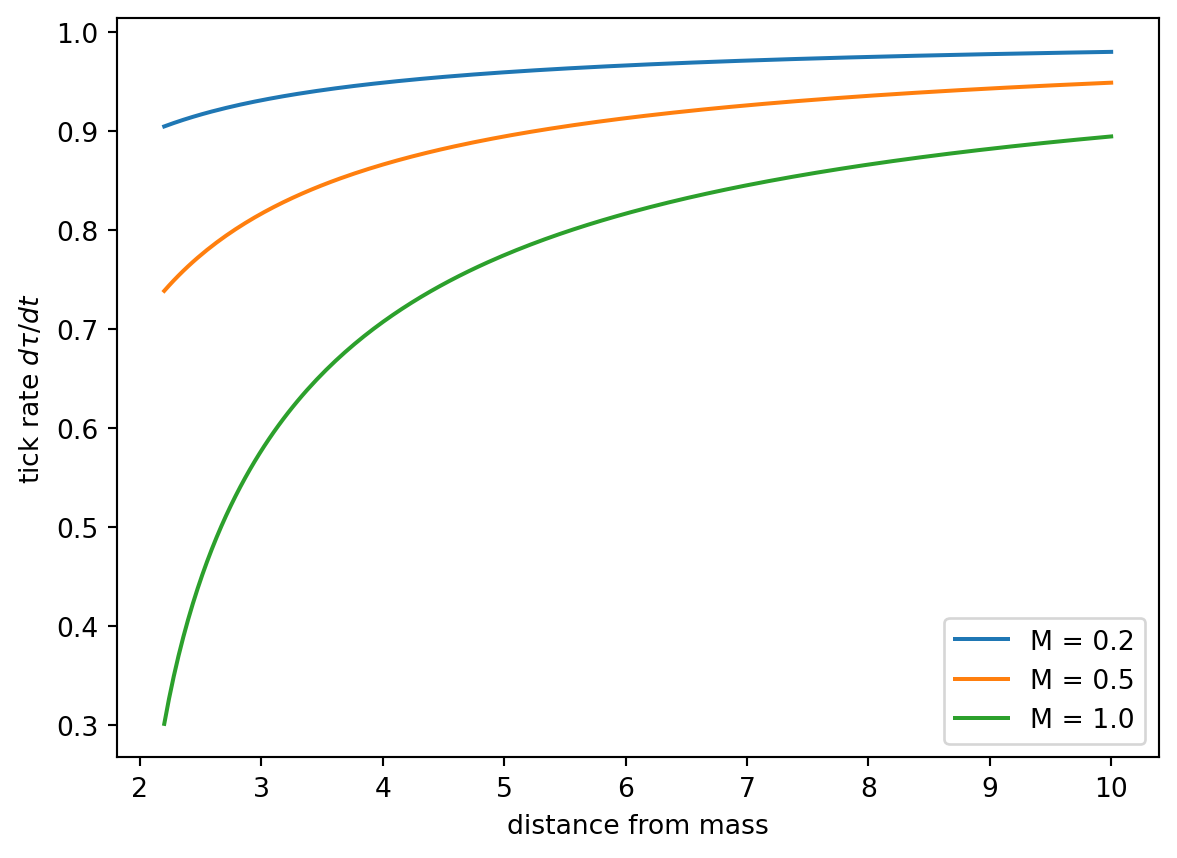
To experiment freely we drop to simulation units with \(G = c = 1\) (see Units and Scales for what that means physically). The forward surrogate is two lines: a point mass \(M\) at distance \(r\) contributes \(\Phi = -M/r\), and the clock’s rate is \(\sqrt{1 + 2\Phi}\). The library wraps this in clocks.physics.clock_rates and rejects any state outside \(|2\Phi|\le0.1\).
Code
import matplotlib.pyplot as pltimport numpy as npfrom clocks import ClockArray, MassConfig, clock_ratesfig, ax = plt.subplots()# start far enough away that every curve satisfies |2 Phi| <= 0.1distances = np.linspace(2.2, 10, 200)for mass in (0.02, 0.05, 0.10): rates = [ clock_rates( MassConfig(positions=np.array([[0.0]]), masses=np.array([mass])), ClockArray(positions=np.array([[d]])), )[0]for d in distances ] ax.plot(distances, rates, label=f"M = {mass}")ax.set_xlabel("distance from mass")ax.set_ylabel(r"tick rate $d\tau/dt$")ax.legend()plt.close(fig)fig
Tick rate vs distance from a point mass. Heavier masses dig deeper wells; every curve approaches 1 (far-away time) at large distance.
NoteThe whole game
That is the whole game: precise timekeeping is gravity sensing. But a camera with one pixel takes a poor picture — and that is exactly the obstacle the next page runs into.