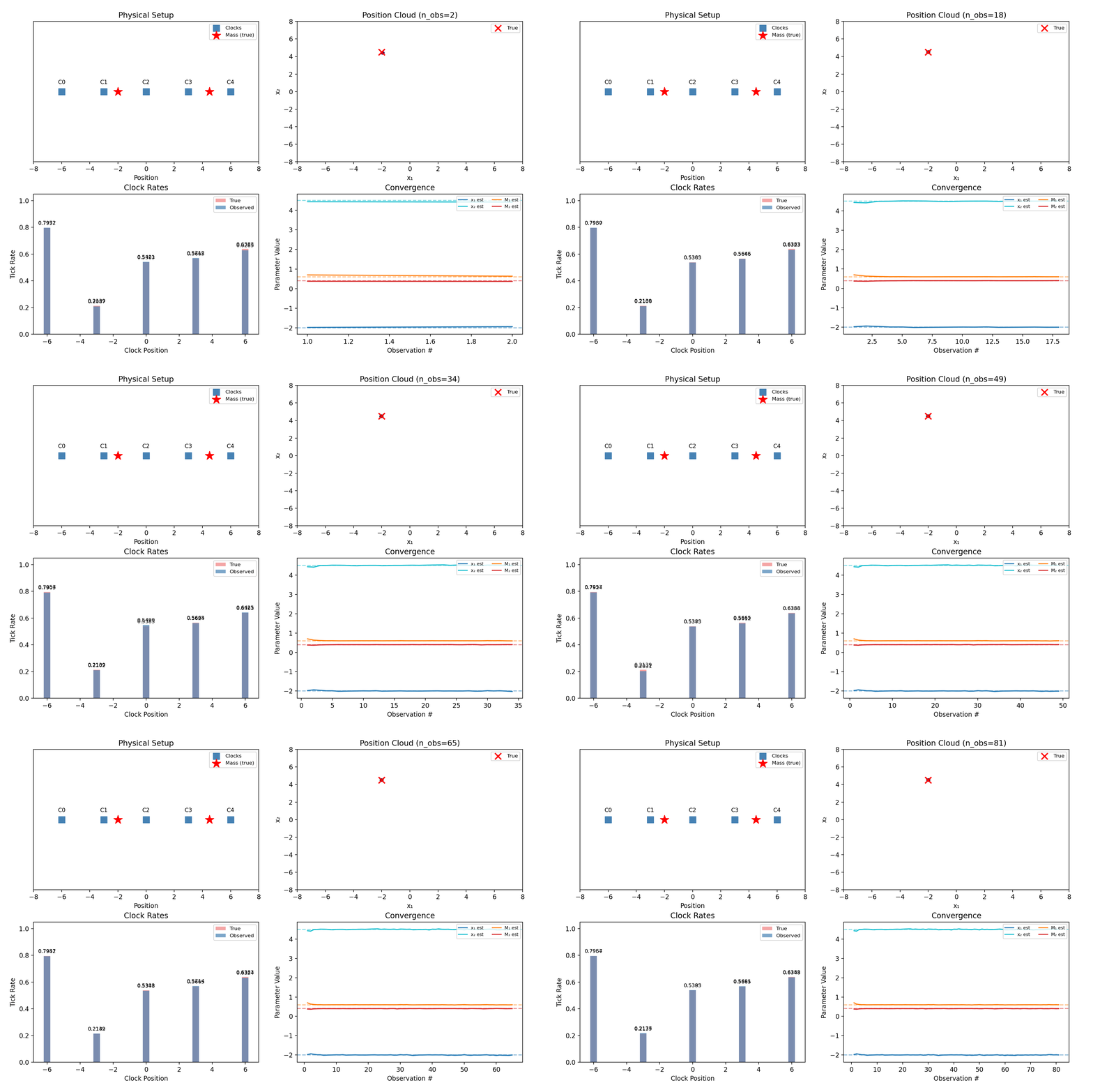
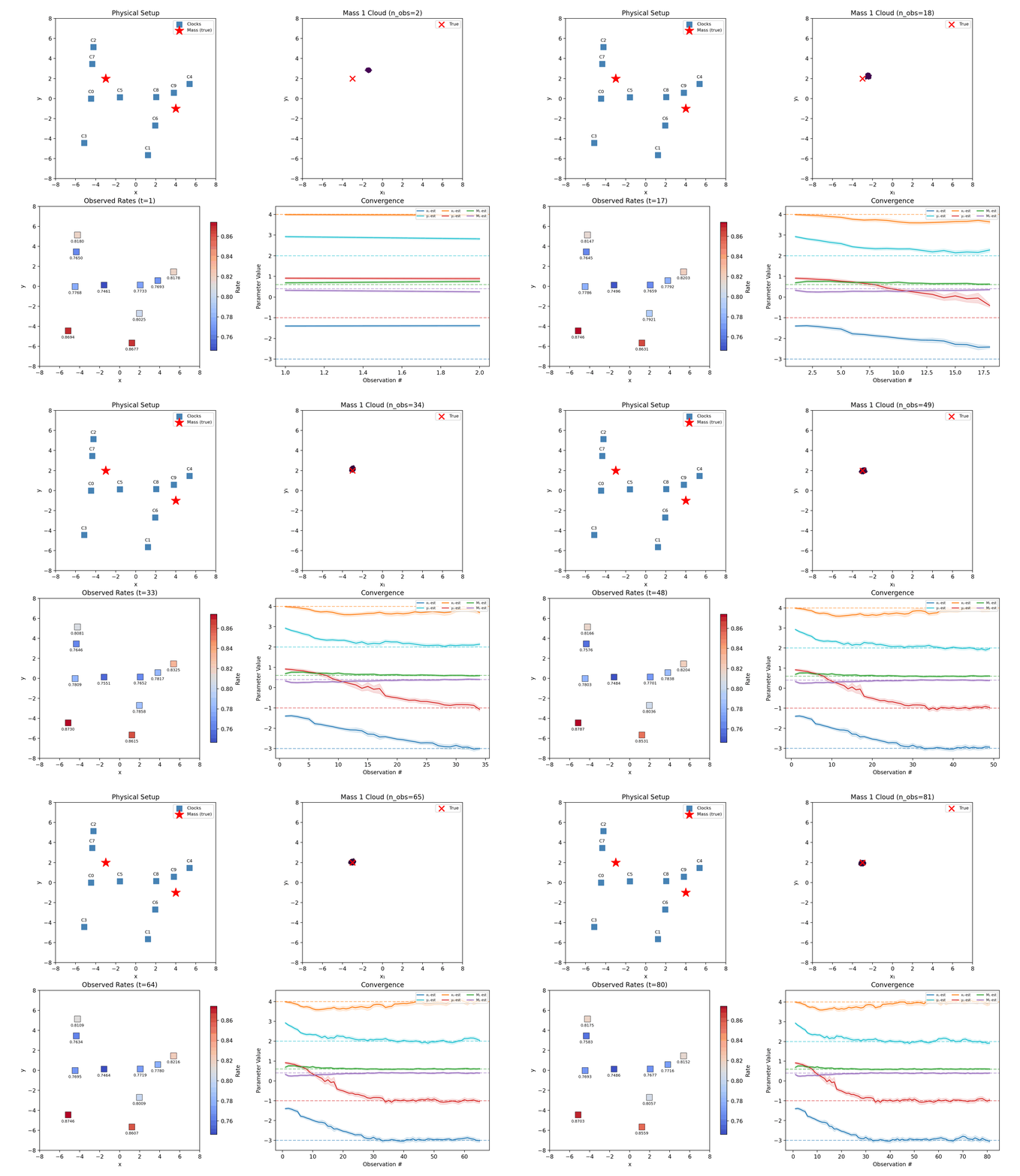
Two masses in 1D means four unknowns (\(x_1, x_2, M_1, M_2\)); on a plane, six. The potential is just the sum of the two wells, but the inverse problem gets qualitatively harder, not merely bigger.
Two masses in 1D: five clocks, four unknowns.
Two masses in 2D: ten randomly placed clocks, six unknowns.
Both committed GIFs are current packaged default outputs from the corrected SMC implementation. Each depicts one named finite realization, not a population recovery rate.
Label switching — an honest limitation
“Mass 1” and “mass 2” are our labels; the physics doesn’t care. A hypothesis with the masses swapped predicts identical clock rates, so the true posterior is perfectly bimodal — and the mean of a bimodal cloud lands meaninglessly between the modes. The library instead represents the normalized ordered version of the exchangeable prior: initial position-mass pairs are sorted together by the first spatial coordinate (so \(x_1 < x_2\) in this notation). During rejuvenation, a proposal that crosses that strict boundary is rejected. Sorting proposals after they are drawn would obscure the proposal density and is not used.
What this does not solve: when the two masses nearly share an x-coordinate, the sort boundary slices right through the posterior, and sampling can become difficult. The 1D demo’s second mass originally sat at \(x_2 = 3.0\), exactly on top of a clock and close enough to cause trouble, and was moved to \(4.5\) to keep the demo crisp. Ordering is an identifiable parameterization, not evidence that the physical masses have intrinsic labels.
Superposition is the enemy
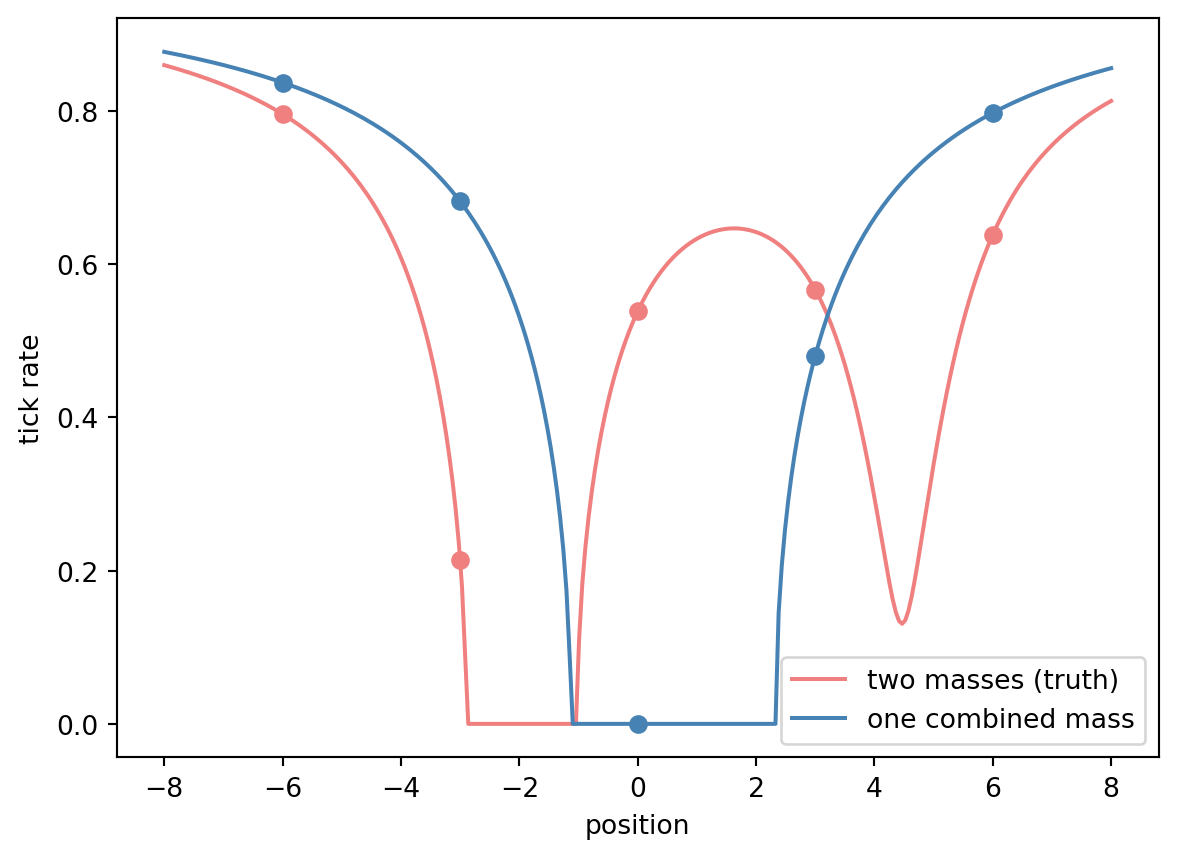
Why is this hard at all? Because summed potentials hide their parts — and the clocks only see the tick rates the summed potential produces:
Tick-rate profiles for the two demo masses against a single mass of the combined weight placed between them. At the five clock positions (dots), the curves nearly agree — the filter must live off the small residuals.
The five clocks each expose a small rate-profile disagreement between these configurations, and repeated independent observations can compound that information. No single reading need be decisive.
NoteThe question behind the question
If two masses can imitate one this well, how would you ever know how many masses are out there? Fixing the number in advance was quietly cheating. The next page stops cheating.