A single clock measures a single number: the potential at its own location, \(\Phi = -M/r\). Every combination of mass and distance with the same ratio produces exactly the same reading. A small mass nearby is indistinguishable from a heavy mass far away — the clock simply cannot tell you which world it lives in.
near light mass: rate = 0.979796
far heavy mass:  rate = 0.979796
Two visibly different universes, one identical clock reading. This is the same mass–distance degeneracy that haunted the 19th-century hunt for Neptune: a perturbation in Uranus’s orbit could be explained by a lighter planet nearby or a heavier one farther out, and only more geometry — more independent measurements — could split the difference.
Breaking it with geometry
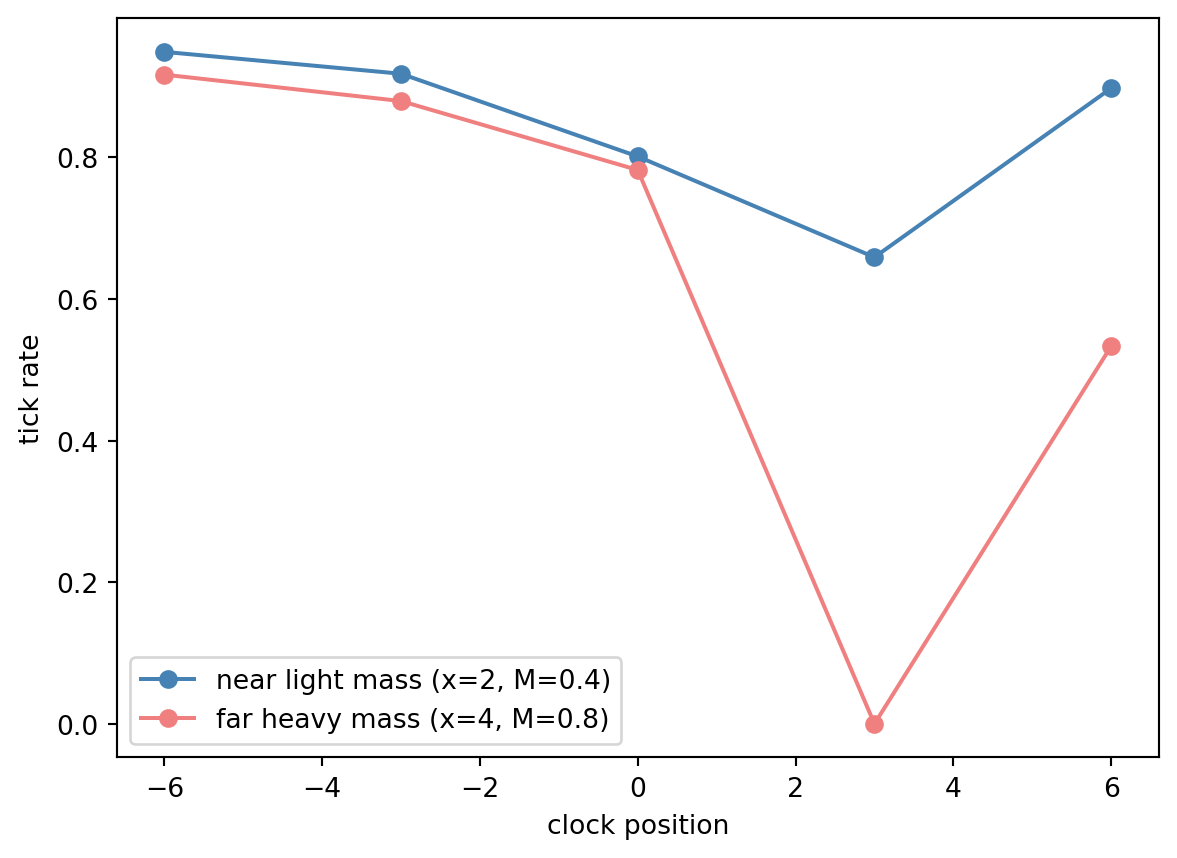
Each additional clock at a different position samples the potential somewhere else. One clock pins down \(M/r\); several clocks pin down how the field falls off, and the falloff is what separates distance from mass. Triangulation, by time dilation. This time the clocks also sit at a small perpendicular offset (track_offset=1.0) from the line the mass lives on — a geometry the next page makes standard.
Code
import matplotlib.pyplot as pltpositions = np.array([[-6.0], [-3.0], [0.0], [3.0], [6.0]])array5 = ClockArray(positions=positions, track_offset=2.0)fig, ax = plt.subplots()for config, label, color in [ (near_light, "near light mass (x=2, M=0.04)", "steelblue"), (far_heavy, "far heavy mass (x=4, M=0.08)", "lightcoral"),]: ax.plot( positions[:, 0], clock_rates(config, array5), "o-", label=label, color=color, )ax.set_xlabel("clock position")ax.set_ylabel("tick rate")ax.legend()plt.close(fig)fig
Across a 5-clock array the two configurations are no longer twins: the nearby light mass produces a sharper, more localized dip in tick rates than the distant heavy one.
With the clocks lifted off the track, even the \(x = 0\) reading is no longer shared — and the other four clocks disagree more strongly. The disagreement carries the information.
NoteThe noise floor
With observation noise \(\sigma\), the array can only distinguish configurations whose rate profiles differ by more than roughly \(\sigma\). That is why every demo on this site feeds the filter many noisy observations rather than one perfect one: each new reading shrinks the set of worlds consistent with the data. How to do that shrinking honestly is the subject of the next page.